
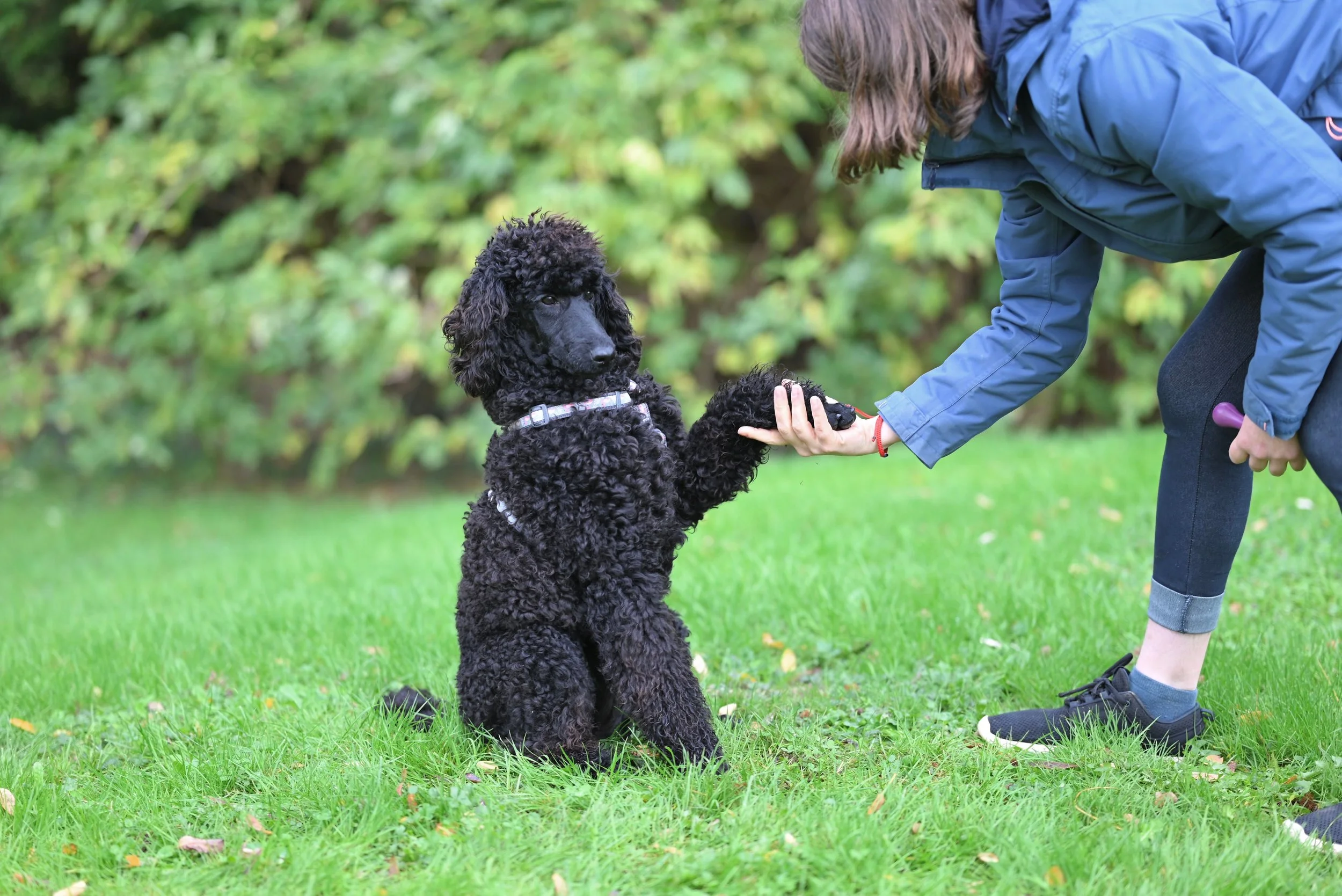
Photo credit: JacLou-DL (via Pexels)
Four Fun Tricks to Train Your Dog: A Step-by-Step Psychology Guide
Training your dog to do tricks is about much more than just showing off for friends. From a canine psychology perspective, it satisfies your dog’s primal need for a "job." In the wild, dogs utilize heavy mental processing to hunt and navigate. In our living rooms, trick training provides that same critical cognitive stimulation, prevents destructive boredom, and builds a deep bond rooted in mutual trust. When you use positive reinforcement, trick training taps into your dog’s natural desire to problem-solve, turning learning into a rewarding game.
The Golden Rules of Trick Training
Before diving into the steps, keep these core psychological principles in mind to ensure a successful session:
Keep sessions short: Train for just 5 to 10 minutes. A dog's intense focus drains their mental energy quickly.
Use high-value rewards: Tiny pieces of chicken or cheese create a positive association, accelerating learning.
Mark and reward: Deliver a treat within one second of the correct movement so your dog connects the exact action with the reward.
End on a win: Always finish a session with a success. This leaves the dog's memory of training highly positive, making them eager for the next session.
"Tricks are the ultimate confidence builder for dogs," says professional dog trainer Sarah Jennings, CTC. "When we move away from strict obedience and into trick training, the pressure drops. Dogs stop worrying about making mistakes and start actively figuring out how to win the game. It transforms their relationship with learning."
1. The "Shake Hands" Trick
This classic trick is highly intuitive because many dogs naturally use their paws to inspect objects or demand attention—a behavior known in canine psychology as "pawing tactile exploration."
Step 1: Have your dog sit directly in front of you.
Step 2: Place a treat in your hand, close your fist, and hold it near your dog's nose.
Step 3: Wait for your dog to paw at your hand to get the food.
Step 4: The instant their paw touches your hand, open your fist and let them have the treat.
Step 5: Once they do this reliably, add the verbal cue "Shake" right before offering your hand.
2. The "Spin" Trick
Spinning in a circle is a great low-impact physical exercise. Psychologically, it builds "proprioception"—your dog’s awareness of where their body is in space, which greatly boosts a timid dog's confidence.
Step 1: Stand in front of your dog while they are in a standing position.
Step 2: Hold a treat right in front of their nose to capture their attention.
Step 3: Slowly guide the treat in a wide circle around your dog’s head toward their tail.
Step 4: Your dog will follow the treat with their nose, forcing their body to turn in a circle.
Step 5: Say "Yes!" and reward them as soon as they complete the full circle.
Step 6: Introduce the verbal cue "Spin" once they smoothly follow your hand movement.
3. The "High Five" Trick
Once your dog knows how to shake hands, upgrading to a high five is an easy transition. It capitalizes on a psychological concept called "shaping," where you build a new behavior out of an old, established habit.
Step 1: Ask your dog to sit.
Step 2: Hold your hand out with your palm facing forward, slightly higher than you would for a standard shake.
Step 3: Your dog will naturally try to raise their paw higher to touch your hand.
Step 4: As soon as their paw taps your open palm, reward them immediately.
Step 5: Pair the action with the verbal cue "High Five" as they get the hang of it.
4. The "Touch" (Nose Target) Trick
Teaching your dog to touch their nose to your hand is an incredibly useful foundation behavior. Dogs experience the world primarily through their scent and snout; targeting harnesses this natural instinct to redirect their attention away from triggers and distractions.
Step 1: Present your flat, open hand a few inches away from your dog's face.
Step 2: Curiosity will prompt them to lean forward and sniff your hand.
Step 3: The exact moment their nose makes contact with your skin, say "Yes!" and give a treat from your other hand.
Step 4: Pull your hand away, then present it again to repeat the process.
Step 5: Add the word "Touch" just as you present your hand.
Troubleshooting Common Challenges
If your dog seems frustrated, walks away, or starts barking, they are experiencing cognitive overload. This means the step is broken down too broadly or the session has gone on too long.
Never use loud vocal corrections or physical force. Punitive measures trigger fear causing learning to cease. Simply lower your expectations, reward smaller movements toward the goal (micro-steps), and keep the energy light and joyful.
I'm a certified pet sitter (which includes dog walking) by the National Association of Professional Pet Sitters, Pet Sitters International, Red Cross Pet First Aid Certified, Bonded, Insured and have over 50 5-star reviews on Google.
You can learn more about me by visiting my Website which is www.sandiegodogwalker.com.
#DogTraining #DogTricks #PuppyTraining #SanDiegoDogs #ClairemontDogs #MissionValleyDogs #HillcrestDogs #NorthParkDogs #sandiegodogwalker
